Small Language Models Are Eating the World (And You Should Care)
Why TinyLlama, Phi, and Mistral 7B beat huge models for 95% of real-world tasks. The efficiency revolution is here.
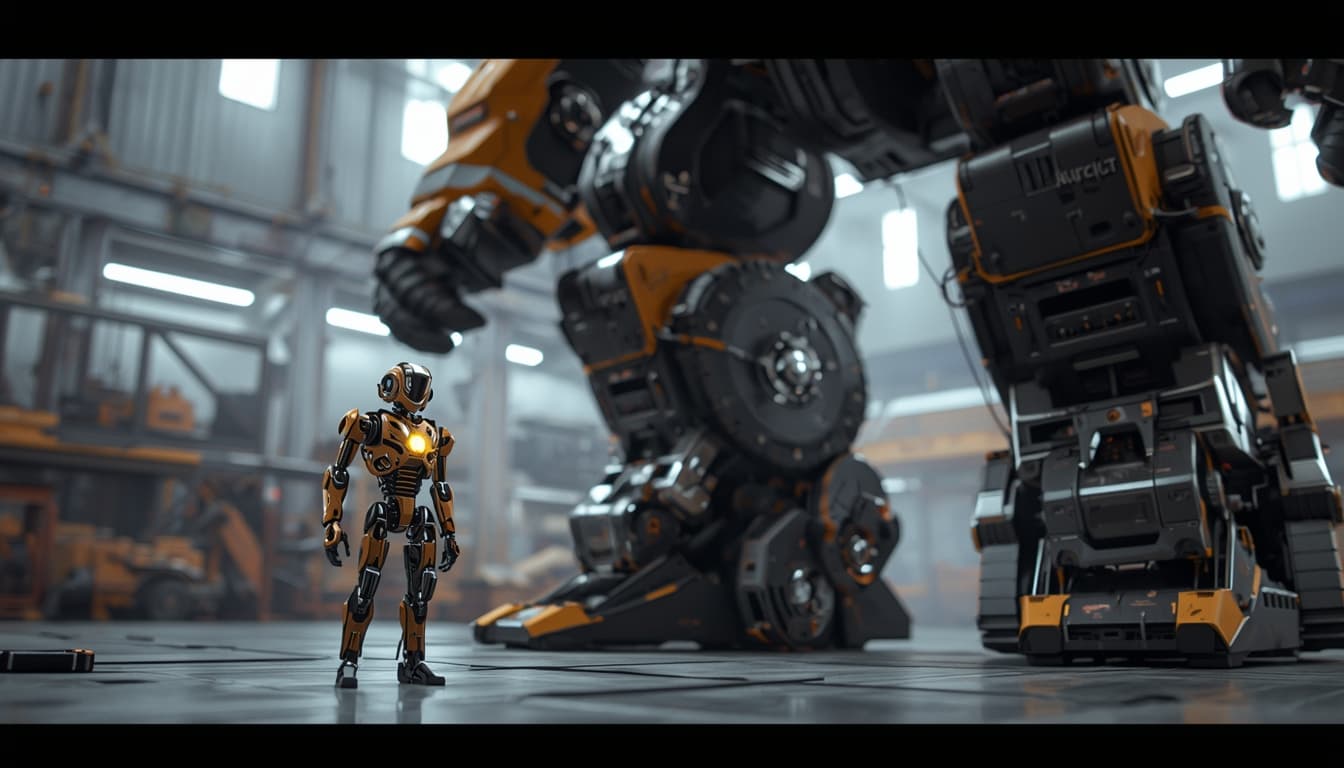
The Premise That's Wrong
For years, the narrative was simple: bigger model = better model.
We cheered when GPT-4 had 1.7 trillion parameters. We assumed bigger was the only way forward. Companies raced to train 100B, 200B, 500B parameter monsters because in scaling, there was safety. In scale, there was truth.
Then something unexpected happened.
In 2024-2025, a bunch of research teams—Microsoft, Meta, Google, tiny companies you've never heard of—started asking a different question: "What if we don't need bigger?"
The answer, in 2026, is: we don't.
You can build production systems with models 100x smaller than GPT-4 and lose almost nothing in quality. For your actual use case—classification, summarization, code generation, customer support—the 3B-7B model probably beats the 70B model. It's faster. It costs less. It runs on your laptop. It's better.
This isn't hype. This is what's actually winning in production.
Why Should You Care?
You're a student. The biggest models require enterprise cloud infrastructure you don't have access to. Small models run on your laptop. You can experiment. You can build. You're not locked out.
You're a startup. Your API costs are murder. At $0.002 per token, running Claude or GPT-4 against thousands of customers is expensive. Mistral 7B running on your own servers costs you electricity. One tenth the price. Sometimes less.
You want to learn. Big models are black boxes. You use the API, you hope it works. Small models let you see what's happening. Run it locally. Inspect the weights. Fine-tune it. You understand it.
You want features the big guys won't give you. Want your model to run offline? Forget Claude. Want to fine-tune on proprietary data? Forget GPT-4. Small open models let you do things that should be impossible.
The world is shifting. Every major tech company is shifting compute from centralized large models to distributed small models. That's not opinion. That's what the shipping code does.
The Size-Quality Tradeoff (It's Better Than You Think)
Let's establish baseline: what matters?
When researchers benchmark models, they test on things like:
- MMLU (multiple-choice knowledge questions)
- HumanEval (can it write correct code?)
- GSM8K (math reasoning)
- Long-context understanding
Here's the stunning finding: a 7B model trained right beats a 70B model trained wrong. And training "right" is now well understood.
The Breakthrough: Phi-4-mini
Microsoft released Phi-4-mini—3.8 billion parameters—and benchmarked it against Llama 3.1 8B.
Phi-4-mini wins. Not by 1%. By 10-20% on reasoning tasks.
How? Not magic. Textbook-quality training data. They trained on carefully curated, high-signal datasets rather than raw internet scrapes. Quality over quantity. It's the opposite of the "LLM scaling law" we believed in.
The implication: the bottleneck isn't model size. It's training data quality.
And that? That changes everything. You can't easily get a 70B model. But you can fine-tune Phi-4-mini on high-quality data specific to your domain. You get a 3.8B model that's better at your task than GPT-4 is.
The Empirical Truth
You don't need GPT-4 for most tasks. Full stop. The benchmarks prove it.
The Efficiency Revolution
Cost Comparison (Real Numbers)
You're running a customer support chatbot. Let's say 10,000 customer messages per day, average 200 tokens per message.
Using Claude API:
- 10,000 messages × 200 tokens × $0.003/token (input) = $6,000/month
- Add output tokens, markup, overhead: realistically $8,000-12,000/month
Using Mistral 7B locally:
- Server cost: ~$200/month (cheap GPU instance)
- Running inference: free (you own the hardware)
- Monthly cost: $200/month
You save $8,000/month. For a startup, that's not negligible. That's runway.
Speed & Latency
Local inference is instant. No queuing. No rate limits. No cold starts.
- Mistral 7B on RTX 4090: ~50 tokens/second (100 token response = 2 seconds)
- Claude API: ~100 tokens/second (but network latency = 500ms minimum)
For real-time applications? Local wins.
Privacy & Security
Your data never leaves your servers. No black-box vendor deciding what gets logged. You own the inference. That matters for:
- Healthcare data
- Financial information
- Proprietary customer data
- Anything with compliance requirements
Which Model For What?
Here's the actual decision tree people should use in 2026:
For Classification & Tagging
Use: TinyLlama 1.1B or Phi-3-mini
You have 1,000 customer reviews. You need to classify them: happy, frustrated, neutral. You need embeddings for similarity search.
TinyLlama does this beautifully. 1.1B parameters, runs on a phone, accurate enough for production. Faster than Mistral. Cheaper than breathing.
Benchmark example: classifying 1,000 reviews takes 15 seconds on a single CPU core.
For Code Generation
Use: Mistral Coder 7B or DeepSeek Coder 6.7B
You want an LLM that helps write Python, JavaScript, SQL. You don't need creativity—you need correctness.
Mistral Coder is purpose-built for this. It beats GPT-3.5 on HumanEval. It's open-weights. You can fine-tune it on your codebase patterns.
For General Chat & Reasoning
Use: Mistral 7B or Phi-4-mini
You want a model that handles anything: write emails, answer questions, brainstorm ideas.
Mistral 7B is the safe choice. It's battle-tested. Works in production at 300+ companies.
Phi-4-mini if you want something smaller and more intelligent. It's the future, but Mistral is the present.
For Math & Complex Reasoning
Use: Qwen 2.5 14B or Llama 3.1 13B
Qwen 2.5 is absurdly good at math. It was trained with higher-quality math reasoning data. It shows.
Llama 3.1 13B is Meta's gold standard. Solid at everything. Great at reasoning. Open weights. Can fine-tune.
For Specialized Domains
Use: Fine-tune Mistral 7B on Your Data
Want a model that understands your medical domain? Your legal documents? Your codebase?
Take Mistral 7B. Fine-tune it on 500-1,000 high-quality examples. Cost: ~$50 on cloud, free if you have a GPU. Result: a 7B model that outperforms GPT-4 on your specific task.
This is the superpower nobody talks about. GPT-4 can't be fine-tuned. Mistral can.
Common Mistakes People Make
Mistake 1: Choosing size instead of quality.
"Llama 2 70B has to be better than Mistral 7B because it's 10x bigger."
No. Mistral 7B is better. Better training. Better architecture. Better instructions. Size isn't destiny.
Mistake 2: Chasing benchmarks that don't matter.
MMLU scores look impressive but don't correlate with real-world performance. Your actual task—customer support, code review, data extraction—doesn't need MMLU performance.
Measure on your task. That's the only metric that matters.
Mistake 3: Not considering inference speed.
A model that takes 30 seconds per response isn't "better" if users close the app after 5 seconds. Latency is a feature. Sometimes faster is better even if it's less intelligent.
Mistake 4: Staying with cloud APIs because "it's simpler."
It's not. You're locked in. You pay monthly. You're at their mercy for rate limits and pricing.
Running models locally is three steps:
- Install Ollama or set up a server
- Download a model
- Query the API
That's it. Same complexity. Better outcomes.
Mistake 5: Assuming small models can't be fine-tuned.
They can. Spectacularly well. Fine-tune Mistral on your domain-specific data and watch it outperform GPT-4.
The Real Future
By 2026, the industry's consensus has shifted. It's not "everyone uses big central models." It's:
- Local inference for latency-sensitive tasks — customer-facing features
- Small models for cost-sensitive tasks — bulk processing, background jobs
- Large models for reasoning and open-ended tasks — rare, when you need it
Most companies will run a mix. Mistral 7B for 90% of tasks. GPT-4 for the hard 10%. Both local and cloud, orchestrated based on task complexity.
And for college students and startups? You can build production systems with open models. You're not locked into "we can only use what the big tech companies offer."
That's the revolution.
Next Steps
- Download Ollama. Literally 2 minutes. ollama.ai.
- Try
ollama run mistral. Talk to a 7B model. See how good it is. - Compare to ChatGPT on your actual task. Summarize a document. Write code. Ask a question. How different is the quality? Probably 5-10% worse. Is that worth the cost savings? Probably yes.
- Think about fine-tuning. What domain-specific data could you collect? 500 good examples? That's enough to fine-tune a model and dominate your niche.
- Build something. Use a small model. Deploy it. Iterate. You now have an unfair advantage: better speed, cheaper cost, more control.
Sign-Off
The hype machine is still fixated on GPT-4 and Claude, writing treatises on billion-parameter models. Meanwhile, production engineers are quietly shipping Mistral 7B to thousands of customers for 1/50th the cost.
You get to pick sides. Do you chase the shiny mega-model that costs money every month? Or do you run the small model that's good enough, fast enough, and costs you nothing?
In 2026, the smart money is on small.